BANGLA SERIES, DAY 1 – 4
DUBLIN – DHAKA
Inside the Fashion Slums of Bangladesh. After my trip to Pakistan, I had fallen in love with the subcontinent and knew I had to return to explore Bangladesh properly, having visited it several years earlier.
WELCOME BACK TO COUNTRY NUMBER 68
The truth is, I couldn’t have told you anything I did that was worthwhile besides buying my dad a cricket ball. I know it has so much to offer, and now I’m giving it a proper chance.
WHERE IS BANGLADESH?
Bangladesh
EXPECTATIONS
After two less-than-enjoyable red-eye flights and a terrible 5-hour layover in Istanbul’s airport (great airport if you work out where everything is), we landed in Dhaka.
I don’t get as excited as I used to for trips, not sure if it’s because I am too busy to think about it, or just numb to the feeling of new trips. But Dhaka was a place I had high hopes for.


Inside the Fashion Slums of Bangladesh
DAILY INFO….
- HOTEL – Intercontinental ($150/night)
- ATTRACTIONS – (+rating)
Gulistan Road, crazy busy
Shahid Nagar River Port
Boat repair yard
Cheapest Hotel in the world
DAY 3
After a poor night’s sleep I was out on the street before lunch. The first stop was riddled with chaos and where else than Gulistan. Nothing can quite prepare your senses (or your stomach) for a day in Dhaka. Gulistan is just an area with a lot of traffic and street markets. I’m sure it sounds like (and is) a lot of people’s idea of hell.
After touring around, checking the old English red double decker buses and some questionable milk tea I then headed to Shahid Nagar River Port, the longest river port in Asia.


Inside the Fashion Slums of Bangladesh
SHAHID NAGAR RIVER PORT
Much of the south of Bangladesh is within a huge delta, making it very prone to flooding, even a quick shower can often bring much of the country underwater. This is the main reason why so many millions of the people rely of these boats to get them around the country.
Boat in the river In Bangladesh. Inside the Fashion Slums of Bangladesh
Inside the Fashion Slums of Bangladesh

Inside the Fashion Slums of Bangladesh
FLAG….

- GREEN FIELD – Represents the lush greenery of Bangladesh and the hope and vitality of its people.
- RED CIRCLE – Symbolizes the blood of those who sacrificed their lives in the 1971 Liberation War for independence from Pakistan. It also represents the rising sun and the hope for a bright future.
SHIP REPAIR YARD
After we headed across the river to the south side to a shipyard. There is an insane industry here with so much going on, from ships being dismantled to ships being refurbished. Everything is done here from the removal of paint to the stripping of the steel. Any material taken from the old ships is then cleaned, repaired, and stocked in the many shops for resale, often to be refitted on one of the ships coming in for a refurb. The work, dirt, and fumes are just insane here, even by South Asian standards.


Inside the Fashion Slums of Bangladesh
RELATED READ: DRONE ISSUES AND AFRICA’S BIGGEST URBAN SLUM
WORKERS
There is no automation here, and exploring this yard was the first time I witnessed Bangladesh’s reliance on manual labor. might you expect a few machines to take the paint off the boat? No, hammer in hand, with sounds so sharp I couldn’t hang around for longer than a minute or 2. No ear protection, headgear, or mask. But some donned a pair of glasses that looked as effective as the flip-flops they had on their feet.


ABOUT THE COUNTRY:
- LANGUAGE – Bengali (Bangla)
- HELLO – “নমস্কার” (Nomoshkar) or more commonly “হ্যালো” (Hello)
- HOW TO CHEERS – “জয় বাংলা!” (Joy Bangla!) or simply “চিয়ার্স!” (Cheers!)
- BEVERAGE OF CHOICE – Tea (Cha/Chai)
- POPULAR SPORT – Cricket
- STAPLE DIET – Rice and fish (Bhat ar Machh)
LOCAL SLUM
Just came across a rubbish river (shocking) was the neighboring slum where some people live better than others. The first house we seen was made out of bamboo and was perched on its own out over the mounds of trash. Its incredibly small and the stove and toilet are literally inches from each other. I couldn’t even begin to think what it would be like to live there.
After making our way around much of the slum we circled back to our boat and headed back to our hotel.


PROTESTS
Once I had finished my dinner and started to do a few hours’ work, I could hear some commotion outside the hotel. Looking like something was going on, I ventured out and came across a crowd of people in front of a line of police, while people with horrendous injuries lay on the ground.
After chatting with a few locals, the protest was demanding that the state give recognition to the people with injuries as freedom fighters. These injuries occurred as part of the recent uprising that occurred against the previous government. The locals feel it is their right to be recognized as such, having risked their lives for the freedom of the country. It was at times hard to watch as clearly some of these people may never walk again.


DAY 4 – CHEAPEST HOTEL IN THE WORLD
Our first stop was the cheapest hotel in the world. Rooms here go for as little as $0.70 per night and are just enough room to lie down in. Think of it as a floating Bangladeshi capsule hotel. Each room comes with a light, a fan, and electricity for charging devices. The fan is much needed, as the room is quite literally a tin box that would melt you in summer.


GUESTS
Most of the guests are here long-term term often here for work. A guy we met had been here 9 years and had recently lost a number of toes after working in the ship yard! Living in a box for 9 years. Seen better solitary!
There’s no kitchen, but street food is so cheap it’s no issue. And finally, the bathroom, a hole in the ground and a bucket for the shower, for water taken from one of the most polluted rivers in the world.


DHAKA’S MOUNTAIN OF RUBBISH
We tried to get into Dhaka’s huge rubbish dump, the largest in the country, but the security weren’t giving in. I’m sure you are wondering why I went into a landfill…so am I.

GARMENT FACTORIES
After a quick trip across the Buriganga, the world’s most polluted river, we took a walk around the Garment Factories of Dhaka. Here. Kids from as young as 10 (in fairness, the vast majority were of age) work and sleep in these factories. The conditions aren’t great, but certainly not as bad as they sound. But take a look at the photos.
Before heading back across the river, we took another walk around the slum to buy the kids sweets we had promised the day before.


FAILED TRAIN RIDE
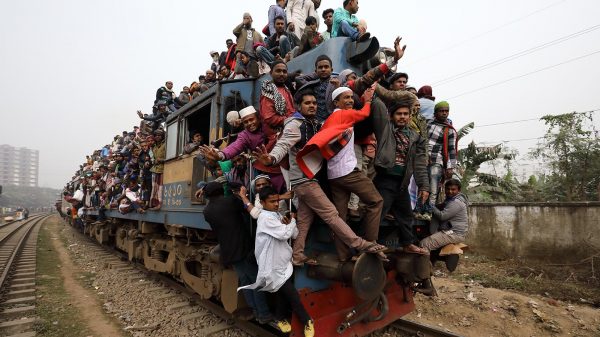
A bucket list item for me is to ride on the roof of a train in the sub-continent. In many places, it’s now been outlawed, and unfortunately, our timing couldn’t have been worse. There are protests all across the city, and all trains are off until further notice. We will get another chance in a few days!


INSIDER TIPS FOR VISTING THE SLUM AREAS OF DHAKA
- Always visit the slums of Bangladesh with a trusted local guide or fixer who understands the social and political sensitivities.
- Photography inside Bangladeshi slums should be done respectfully ask permission wherever possible.
- Expect intense sensory overload in Bangladesh slums, Dhaka areas, from noise to smells to crowds.
- Dress modestly and avoid drawing attention when moving through slums that Bangladesh travellers rarely see.
- River ports and industrial zones are often closely connected to nearby slum communities timing and access matter.
TODAY’S YOUTUBE VIDEOS
If you want to see today from a different perspective and catch a few different stories from the front row, then check out today’s YouTube videos below.
FINAL THOUGHTS
I knew this place would be chaotic, but I didn’t expect it to be on another level than Pakistan. So much to see and do, it’s a great first impression.
SAFE TRAVELS, DS x
172/229
NEXT UP
THE WORLD’S HARDEST JOBS!! Click to read.
This post is episode 1 of The Bangla Series, for the entire series click here.
To see a different side of my trip head to my social channels; YouTube, Instagram & TikTok. Links at top of the page.

Question Time
- Would you like to visit Bangladesh?
- What would you most like to do here?
Let me know in the comments below . . .